
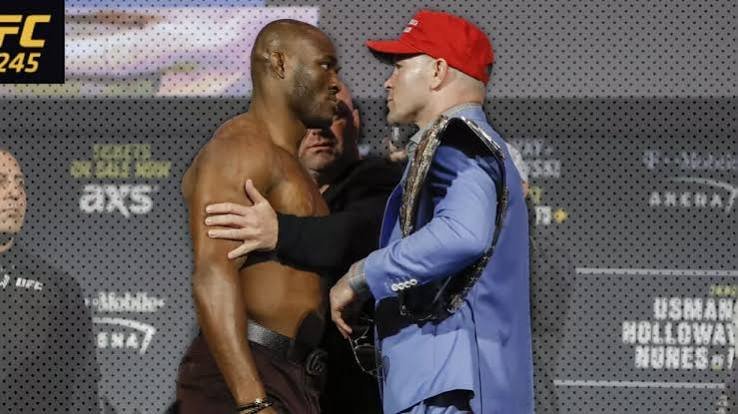
Some UFC rivalries are built on trash talk. Others are built on bad blood. Colby Covington and Kamaru Usman had both, but what made their rivalry special was that the two men eventually backed up almost everything they said inside the Octagon.
They fought twice for the UFC welterweight championship. Both times, the fight went deep into championship rounds. Both times, Covington refused to disappear. And both times, Usman found a way to prove why he was the man holding the belt.
Their rivalry wasn’t just about who was the better fighter. It was about two elite wrestlers who had developed remarkably similar engines, yet approached the fight game in very different ways.
UFC 245: When Trash Talk Finally Met Reality
By December 2019, Colby Covington had become one of the most talked-about fighters in the UFC. He had built a public identity around outrageous statements, political controversy, and an aggressive persona that made him impossible to ignore.
But beneath the noise was a serious fighter. Covington had an exceptional wrestling background, seemingly endless cardio, and a style designed to overwhelm opponents with volume.
Usman was the champion, and he wasn’t interested in playing along with Covington’s performance.
At UFC 245 in Las Vegas, the two finally met.
What followed was not the wrestling-heavy stalemate some fans expected. Instead, they spent much of the fight exchanging punches, combinations, and body shots at a pace that would have exhausted most welterweights.
Covington kept moving forward, throwing in volume and trying to force Usman into uncomfortable exchanges. Usman answered with powerful punches, sharp counters, and punishing body work.
Then the fight took a dramatic turn.
Usman broke Covington’s jaw during the contest, but Covington continued fighting. He absorbed heavy shots and kept trying to turn the fight around, demonstrating a level of toughness that even his harshest critics had to acknowledge.
As the fifth round unfolded, Usman began to take control. He dropped Covington twice before the referee stopped the contest at 4:10 of the final round.
Usman had won by TKO.
The champion had delivered on his promise, but Covington had made him work for every second of it.
That distinction matters. Covington lost the fight, but he didn’t look like a pretender who had talked his way into a title shot. He looked like a genuine championship-level opponent who had pushed the champion to the limit.
The Rematch: Covington Came Back With a Different Plan
Nearly two years later, the rivalry reached its second chapter at UFC 268 in November 2021.
By this point, Usman had established himself as one of the best pound-for-pound fighters in the world. He had improved his striking considerably, knocked out Jorge Masvidal, and developed the confidence to compete in extended stand-up exchanges.
Covington, meanwhile, had a question to answer: could he make the adjustments necessary to beat the man who had already stopped him?
The rematch suggested that he had learned from the first encounter.
Covington was more competitive in the striking exchanges and showed impressive composure when Usman landed clean shots. He also survived two knockdowns in the second round, recovering well enough to continue fighting at a high pace.
That moment revealed something important about both men.
Usman had the power to hurt Covington badly, but Covington had the resilience and conditioning to make him keep working. The challenger refused to fold, even when the fight appeared to be slipping away.
As the rounds progressed, the contest became a battle of adjustments. Usman used his jab and powerful right hand to control exchanges, while Covington tried to maintain his relentless output and find openings.
After five rounds, the judges awarded Usman a unanimous decision, with all three scoring the fight 48–47.
The scorecards reflected just how competitive the rematch had been. Covington had made it to the final bell and remained dangerous throughout, but Usman had done enough to retain his championship.
Two fights. Two victories for Usman. No easy nights.
The Most Interesting Part: They Were Supposed to Be Wrestlers
Here’s what makes this rivalry worth revisiting.
Both men came from elite wrestling backgrounds. On paper, their credentials suggested that their matchups might revolve around takedowns, control time, and grappling exchanges.
Instead, much of their rivalry became a high-level striking contest.
Usman developed a heavy, accurate right hand and became increasingly comfortable fighting at boxing range. Covington relied on volume, pace, and constant pressure, often throwing combinations to keep his opponent occupied.
Their wrestling still mattered, even when they weren’t shooting for takedowns. Each fighter had to respect the possibility of being taken down, which influenced distance, positioning, and defensive decisions.
That threat helped turn their striking exchanges into a tactical battle rather than a simple punching contest.
Usman was often the more damaging puncher. Covington was willing to throw more frequently and maintain pressure. The contrast made both fights compelling.
It was also proof that elite wrestling can become the foundation for excellent MMA striking. Neither man needed to abandon his wrestling background to become a dangerous boxer. They used it to create a more complete fighting style.
Did Colby Covington Deserve More Credit?
Covington’s reputation has often overshadowed his accomplishments.
His public persona made him a divisive figure, but his performances against Usman demonstrated that he belonged among the division’s elite. Few fighters could sustain his pace, absorb his level of punishment, and remain competitive over five rounds against a champion of Usman’s caliber.
The first fight ended with Covington being stopped, but he continued fighting after suffering a serious injury to his jaw. In the rematch, he survived two knockdowns and pushed Usman through another full five-round contest.
That doesn’t make him the winner. It does, however, make the rivalry more impressive.
Covington was not simply a loud challenger who got exposed when he finally faced a champion. He was a legitimate contender who lost to a fighter operating at an exceptionally high level.
At the same time, toughness alone cannot erase the difference between winning and losing. Usman won both fights because he combined durability with effective offense, better damage in key exchanges, and the ability to deliver when the championship was on the line.
Who Was Actually the Better Fighter?
The head-to-head record gives a clear answer: Kamaru Usman won both encounters.
But the reasons are more interesting than the numbers.
Usman was the more powerful and damaging striker in their meetings. He found the shots that changed the first fight and did enough in the second to earn another decision. His ability to adapt from a wrestling-first approach into a more dangerous striking game was central to his success.
Covington’s advantages were his relentless pace, volume, and extraordinary ability to recover under pressure. He forced Usman into difficult exchanges and showed that the champion could not simply overpower him without resistance.
The rivalry also exposed a key difference between being difficult to beat and actually winning. Covington was difficult to beat. Usman was better at turning competitive moments into decisive results.
That is what separates a great contender from a champion at the very top of the sport.
Final Verdict: Two Fights That Delivered on the Hype
The Covington–Usman rivalry worked because the personalities were loud, the stakes were enormous, and the fights delivered something real.
The first encounter ended in a dramatic fifth-round stoppage. The second became a tense, closely contested championship battle that went the distance. Neither fight was a simple showcase of one fighter overwhelming the other.
Usman left the rivalry with two victories and his reputation as an elite champion strengthened. Covington left without the belt, but with proof that he could compete with one of the greatest welterweights of his era.
The biggest lesson from their rivalry is that talking can sell a fight, but only performance can define it. Covington brought the noise. Usman brought the results. And when the Octagon door closed, both men gave fans a rivalry worthy of the championship it was fought for.