
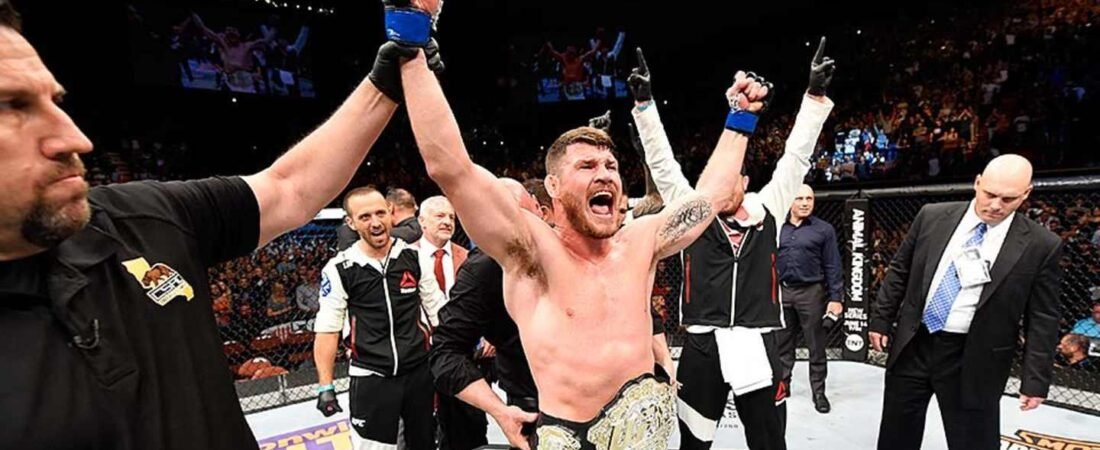
Michael Bisping spent more than a decade chasing the UFC middleweight championship. He suffered painful defeats, faced serious eye injuries, and repeatedly watched opportunities slip away. Many fighters would have struggled to continue under those circumstances.
But Bisping refused to give up. On June 4, 2016, at UFC 199, he shocked the MMA world by knocking out Luke Rockhold in the first round and becoming the UFC middleweight champion. His victory was more than a championship win. It was the defining moment of a career built on persistence, resilience, and an unwillingness to accept defeat. UFC 30th Anniversary
A Difficult Road to the UFC
Born in England, Michael Bisping did not come from a life of fame and fortune. Before becoming a professional fighter, he worked various jobs to support himself and his family. Fighting eventually gave him an opportunity to pursue something he genuinely loved.
His breakthrough came in 2006 when he won The Ultimate Fighter 3 and earned his place in the UFC. Bisping quickly established himself as a tough competitor with strong striking, relentless pressure, and a personality that made him difficult to ignore.
However, reaching the UFC was only the beginning. Winning a championship would prove far more difficult.
Setbacks That Could Have Ended His Dream
Bisping built a reputation as a dangerous middleweight, but his championship ambitions suffered repeated setbacks. Losses to elite opponents prevented him from reaching the top, while questions about his wrestling and overall game forced him to keep improving.
His most serious challenge came in 2013, when a fight against Vitor Belfort left him with a detached retina in his right eye. The injury required surgery, and the retina detached again during his recovery, leading to another operation. His future in MMA became uncertain.
For a fighter whose career depended on reading an opponent’s movements and reacting to incoming strikes, the injury was particularly devastating.
Bisping eventually returned to competition, but his comeback was not immediate or easy. He lost to Tim Kennedy in his first fight back after the injury. Instead of walking away, he continued training and rebuilding his form.
The Comeback Begins
Bisping gradually regained momentum with victories over opponents including C.B. Dollaway and Thales Leites. In February 2016, he defeated former longtime champion Anderson Silva in a memorable five-round contest in London.
The win demonstrated that Bisping could still compete with the best in the division. It also put him back in the championship conversation after years of disappointment.
Then came an unexpected opportunity.
Luke Rockhold was scheduled to defend his middleweight title against Chris Weidman at UFC 199, but Weidman withdrew because of injury. Bisping received the call to replace him with just 17 days’ notice.
The challenge was enormous. Rockhold had already defeated Bisping convincingly in their previous meeting in 2014. He was the reigning champion, and many observers expected him to win again.
Bisping had spent years waiting for a title shot. Now, at 37, he finally had his chance.
UFC 199: The Night Everything Changed
On fight night, Bisping entered the Octagon with little time to prepare and plenty of doubters to silence.
Rather than allowing Rockhold to control the fight, Bisping attacked aggressively from the opening moments. He landed a powerful left hand that hurt the champion, followed by another clean shot that sent Rockhold to the canvas.
Bisping continued his assault, forcing the referee to stop the contest at 3 minutes and 36 seconds of the first round.
Against the odds, he had done it.
Bisping became the first British fighter to win a UFC championship, completing a journey that had taken roughly a decade of UFC competition. The fighter who had endured repeated disappointments was now the middleweight champion of the world.
UFC
+1
Proving It Was No Fluke
Winning the title was an extraordinary achievement, but Bisping still had more to prove. In October 2016, he defended his championship against Dan Henderson at UFC 204.
Henderson had previously knocked Bisping out with a devastating strike at UFC 100, making the rematch especially personal. This time, Bisping won by unanimous decision, avenging the earlier defeat and successfully defending his belt.
He eventually lost the championship to Georges St-Pierre at UFC 217 in November 2017. He fought Kelvin Gastelum shortly afterward before retiring from professional MMA in 2018.
UFC
+1
Although his reign as champion did not last forever, his achievement at UFC 199 remained one of the most remarkable championship comebacks in UFC history.
Michael Bisping’s Legacy: Never Count Yourself Out
Michael Bisping’s story is not simply about winning a championship. It is about surviving the moments when success seems increasingly unlikely.
He endured defeats, recovered from a career-threatening eye injury, and continued competing despite years of frustration. When his opportunity finally arrived, he was ready to seize it.
His journey also shows why a fighter’s career cannot be judged by a single loss or setback. Bisping’s earlier defeat to Rockhold did not define their rivalry, just as his injury did not define the rest of his career.
Instead, his response to adversity became the defining part of his legacy.
Michael Bisping’s comeback proves that setbacks do not have to be the end of the story. Sometimes, the moment everyone doubts you becomes the moment that changes everything.